The KNX Association is recognized worldwide as a leading authority in standardizing smart home and building systems. With more than three decades of experience, it has established an open, manufacturer-independent protocol that enables interoperability among products from hundreds of different companies.
This article provides a complete overview of the KNX smart building standard — its history, international activities, and the key benefits it brings to residential, commercial, and industrial buildings. If you’re looking for a detailed history of the association itself, you can read our dedicated article on KNX Association history.
In This Series
This article is part of a complete educational series on KNX. If you’d like to explore specific topics in more depth, here’s what’s available:
- KNX Association History: From EIB to the Global KNX Standard — the origins and evolution of the KNX Association
- KNX as an International Standard: Activities of the KNX Association — how KNX became a globally recognized standard
- KNX vs Conventional Installation: What’s the Difference? — the physical and architectural differences
- KNX System Specification: Media, Configuration & Interworking — media types, E-Mode and S-Mode, and how devices interoperate
- KNX Success Figures & Key Advantages — global adoption in numbers and the benefits of KNX
- KNX Application Examples: Real-World Use Cases — nine practical examples of KNX in action
More articles in this series will be added as new topics are published.
What Is the KNX Smart Building Standard?
KNX is a worldwide standard for home and building automation, developed and maintained by the KNX Association. It allows products from different manufacturers to work together seamlessly on a single installation — a concept known as interworking.
Unlike proprietary systems, KNX is open and manufacturer-independent. This means:
- Any certified KNX device can communicate with any other certified KNX device
- You are not locked into a single vendor
- The system can be expanded, modified, or upgraded at any time
Today, KNX is recognized as a standard by major international bodies and is used in projects ranging from small apartments to large commercial towers.
A Brief History: From EIB to KNX
The KNX Association was founded in 1990 in Brussels, Belgium, under the name EIB Association, with the goal of promoting smart homes and buildings and introducing the European Installation Bus (EIB) system.
In 1999, a major merger took place with two other European associations — BCI (Batibus) and the European Home Systems Association (EHS). This merger led to the creation of a unified standard and the renaming of the organization as the KNX Association.
👉 For a deeper look at the origins, founding members, and the 1999 merger, read our article on KNX Association history.

International Activities of the KNX Association
To achieve its goals, the KNX Association carries out extensive activities at the international level. These activities ensure that the standard remains open, reliable, and globally recognized.
A) Technical Development and Standard Promotion
The association continuously works with its members (manufacturing companies) to develop and improve the KNX standard and to promote it worldwide.
B) ETS Software Development
ETS is the common, manufacturer-independent software for designing, configuring, and commissioning all KNX devices. Developing and supporting this software is one of the association’s most central activities.
C) Certification and the KNX Logo
Through rigorous testing procedures on manufacturers’ products, the association grants the KNX logo to compliant products. This logo guarantees the product’s quality and its interoperability with all products bearing the KNX logo.
D) Training and Certification
By providing educational documentation and certifying accredited training centers around the world, the association trains skilled professionals and standardizes technical knowledge in this field.
E) International Standardization
One of the association’s most significant achievements is the recognition of KNX by major international standardization bodies — including CENELEC (EN 50090), CEN (EN 13321), ISO/IEC (14543-3), the Chinese National Standard (GB/T 20965), and ASHRAE (ANSI/ASHRAE 135).
👉 For the full list of standardization milestones and the association’s wider activities, read our article on KNX as an International Standard.
Today, the KNX Association hosts more than 500 member companies from around the world — a clear reflection of the industry’s broad adoption of this standard.
F) Developer Support
The association provides technical support and consultation for companies intending to develop KNX-compatible products.
G) Promotional Activities
Participation in international exhibitions, publication of brochures, website launches, and other marketing measures to showcase the capabilities of the KNX system.
Key Benefits of the KNX Standard
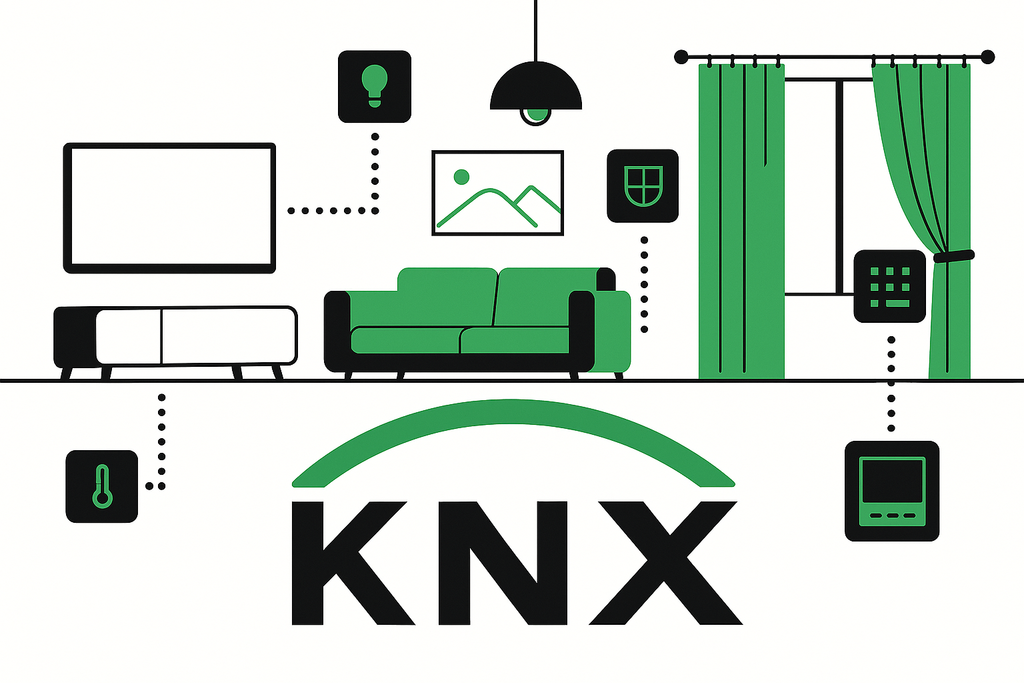
The KNX standard delivers measurable benefits across safety, energy efficiency, flexibility, comfort, and future-proofing — all supported by a global ecosystem of certified products, qualified professionals, and hundreds of thousands of installed projects worldwide.
👉 For a detailed breakdown of each advantage — and the numbers behind KNX’s global adoption — read our article on KNX success figures and key advantages.
Conclusion
By creating an open, standardized, and interoperability-based ecosystem, the KNX Association has revolutionized the smart building industry. Its extensive international activities — from technical development to standardization and training — have laid solid foundations for the global adoption of this technology.
The countless benefits of the KNX system, from energy savings and enhanced safety to unmatched flexibility, make it a logical and future-proof choice for any type of building. KNX is not merely a protocol; it is an international standard that is shaping the future of smart buildings.
To access more specialized educational articles in this field, explore our other articles in this series — starting with the history of the KNX Association.
📌 Key Takeaways
- KNX is an open, manufacturer-independent standard for home and building automation.
- The KNX Association was founded in 1990 (as EIB Association) and renamed in 1999 after a major merger.
- KNX is recognized by CENELEC, ISO/IEC, ASHRAE, and the Chinese National Standard.
- The standard delivers energy savings, safety, flexibility, comfort, and future-proofing.
- For the full history of the association, see KNX Association history.

1 thought on “KNX Smart Building Standard: A Complete Overview”